
Key Takeaways
-
Vibe coding lets you build interactive Roblox obbies using natural language prompts instead of learning Lua scripting.
-
Nilo’s browser-based platform gives you instant 3D feedback, real-time multiplayer collaboration, and a quick, no-install setup.
-
Follow the 7-step tutorial to create a bouncing ball obby with physics, controls, moving obstacles, and friend testing.
-
Export assets directly to Roblox Studio with automatic LOD and polygon limits for smooth compatibility.
-
Start building in Nilo’s free open beta and vibe code your own playable games.
How Vibe Coding Works in Practice
Vibe coding turns natural language prompts, whether you talk, text, or send images, into working game code with instant 3D feedback. You skip Lua syntax and debugging and simply tell the AI what you want, like “Make the ball bounce when I press space” or “Add a moving platform that goes back and forth.”
This approach removes the translation layer between your imagination and execution. Traditional scripting forces you to learn programming languages, understand syntax rules, and fix technical errors. Vibe coding lets you stay focused on game design while the AI handles the technical work in the background.
But unlike prompt-only tools like Rosebud AI that generate games from text descriptions, vibe coding in Nilo gives you hands-on control inside a real 3D environment. You are not just prompting: you are building, tweaking, and playing in real time. One builder summed it up: “You made me enjoy vibe coding. The code assistance works almost flawlessly, other experiences have just been frustrating at best.”
Why Nilo Fits Roblox Builders Who Vibe Code
This hands-on vibe coding style works best when your platform supports it from the ground up. Nilo stands out as a browser-based game engine built specifically for aspiring builders like you. No installation is required: you just open a link and start creating. Real-time multiplayer collaboration lets you invite friends to build together by sharing your project’s URL.
For Roblox builders, Nilo’s export system automatically prepares your creations for Roblox’s strict performance requirements. Roblox enforces a 10K triangle limit per mesh, and assets that exceed it will not import correctly. Nilo’s level of detail (LOD) systems, which reduce polygon counts at a distance to improve performance, keep you under this limit automatically, then package everything in FBX and glTF formats that Roblox Studio accepts without cleanup.

Nilo also has a thriving Discord community where you can share techniques and showcase your work. The platform connects multiple AI model providers, including Meshy, Tripo, and Cartwheel, behind one interface. You benefit as these models improve without switching tools or changing your workflow.
Rosebud AI focuses on prompt-only generation without a 3D engine, while Roblox Studio requires installation and scripting knowledge. Nilo combines the accessibility of browser-based creation with the depth of a real game engine. The Game Developers Conference’s 2025 report found that more studios are adopting generative AI, yet many tools still expect strong technical skills. Nilo gives you a more direct path from idea to playable world. Explore Nilo’s open beta and build while you play.
Nilo Setup: From Sign-Up to First World
Getting started with Nilo takes less time than downloading most games. Go to play.nilo.io and sign up for your free account. You receive free Nilo Bits each month for AI generation plus unlimited access to core building features.
After you log in, click “New World” to create your first world. You see Nilo’s intuitive interface with a radial menu for quick object creation and an inspector panel for detailed property editing. The interface works across desktop and mobile devices, so you can build wherever you are.
The whole experience feels more like playing a game than using a complex tool. Objects have physics and collisions by default, so everything you create feels interactive right away. You can start building immediately without digging through long settings menus or learning heavy software workflows. Jump into Nilo’s open beta and try your first world.
7-Step Vibe Coding Tutorial: Build a Bouncing Ball Obby
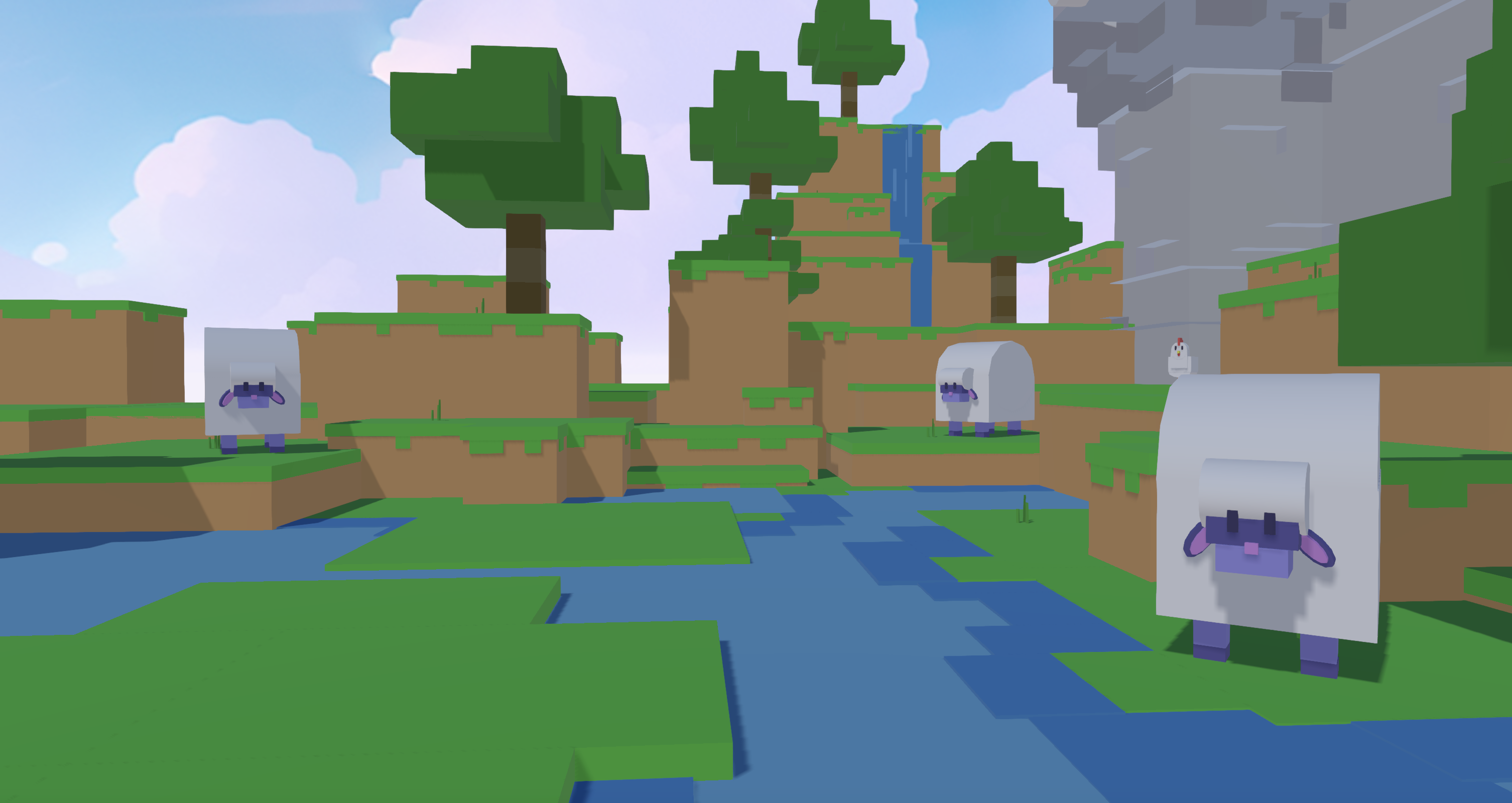
This tutorial walks you through a playable obstacle course that shows what vibe coding can do. You will create a bouncing ball game where players move across platforms and dodge obstacles using natural language commands.
Step 1: Generate Your Ball and Platform
Use the radial menu to create a sphere, then open the AI chat and type: “Make this a bouncing ball with realistic physics.” Nilo applies physics properties automatically. Create a platform using a cube primitive and scale it to form your starting area.
Step 2: Add Bounce Physics
Select your ball and tell the AI: “Make this ball bounce higher each time it hits a surface.” The AI generates the physics code instantly, and you see the bouncing behavior in real time. You avoid Lua scripting and rely on clear natural language instead.
Step 3: Create Player Controls
Add input handling by saying: “Let players control the ball with WASD keys and make it jump with spacebar.” The AI generates the control scheme and applies it immediately. Enter play mode and test the controls so you can confirm that your ball responds to keyboard input.
Step 4: Add Moving Obstacles
Create extra platforms and tell the AI: “Make this platform move back and forth automatically.” You can set speed and distance with prompts such as “Move 10 units left and right every 3 seconds.” Each obstacle becomes interactive without manual scripting.
Step 5: Invite Friends for Multiplayer Testing
Share your world’s URL with friends through Discord or any messaging app. They can join instantly without downloading anything. Test your obby together, with each player controlling their own ball. Real-time collaboration lets you build and play at the same time.
Step 6: Fine-tune Variables
Adjust game feel by modifying variables directly. Change “speed = 10” to “speed = 20” in the code editor, or use natural language like “Make the ball move faster” or “Reduce gravity by half.” You see changes instantly without waiting for a compile step.
Step 7: Optimize and Export
Use Nilo’s LOD slider to prepare polygon counts for Roblox compatibility. Export your assets as FBX or glTF, then import them into Roblox Studio. The optimization keeps your creation within Roblox’s performance requirements while still looking clean.
You just built a playable multiplayer obby without writing a single line of traditional code. The whole journey from concept to playable game takes minutes instead of hours. Try vibe coding your own obby in Nilo’s open beta.
Prompting Tips, Fixes, and Troubleshooting
Effective vibe coding starts with precise, specific prompts. Instead of saying “make it better,” describe exactly what you want, such as “increase jump height by 50%” or “add a red glow effect to the ball.” The AI responds more accurately to concrete instructions than to vague requests.
When logic feels off or a feature does not behave as expected, refine your prompt with more detail. If a moving platform stutters, try “Make the platform move smoothly between points A and B over 4 seconds.” For performance issues, Nilo’s automatic LOD system handles most optimization, and you can still adjust polygon counts manually with the detail slider.
Small, steady iterations keep your project stable. Build one feature, test it, then add the next piece. This rhythm helps you spot issues early and keeps your world playable while you experiment.
The Nilo Discord community shares troubleshooting tips and successful prompt patterns. Common fixes include being specific about timing, like “every 2 seconds,” directions such as “move left then right,” and conditions like “when the player touches the platform.” Join the open beta and learn from other builders in real time.
Exporting Your Vibe-Coded Game to Roblox
Nilo’s one-click export system handles the technical side of Roblox compatibility for you. Click the export button and choose FBX or glTF format, both work directly in Roblox Studio. The automatic LOD optimization keeps your models within Roblox’s triangle limits while still looking sharp.
Many AI tools generate messy geometry that needs Blender cleanup. Nilo focuses on producing Roblox-ready assets from the start. Rigged characters keep their animations, and interactive objects preserve their physics properties during export. Nilo manages polycount so models work in Roblox Studio and other platforms without extra steps.
The export process keeps your vibe-coded behaviors and interactions intact. After you import the files into Roblox Studio, your bouncing ball obby assets behave the same way they did in Nilo. This end-to-end workflow reduces tool-switching and helps you stay in a creative flow. Export your first Nilo world to Roblox during the open beta.
Advanced Vibe Coding Ideas to Try Next
Once you feel comfortable with basic vibe coding, you can explore multiplayer-specific features with simple prompts. Say “Add friend synchronization for this object” or “Make this collectible disappear for everyone when one player grabs it.” Voice prompts work alongside text, so you can talk to the AI while you build.
Image-to-logic features let you upload sketches or reference images and say, “Make this behave like the drawing shows.” Recent research in AutoUE demonstrates modular logic systems, much like how Nilo breaks complex behaviors into smaller, manageable pieces.
The community world browser lets you remix creations from other builders. You can clone interesting mechanics, study how they work, and adapt them for your own projects. This kind of collaborative learning speeds up how quickly you understand what is possible with vibe coding. Browse, remix, and share worlds in Nilo’s open beta.
Frequently Asked Questions
Do I need coding skills to use vibe coding?
You do not need coding knowledge to start. Vibe coding uses natural language in any language, including English and Spanish. You can also tinker with variables directly in the code editor and slowly pick up programming concepts. It feels similar to right-clicking “View Source” on a webpage, but for games.
How is Nilo different from Rosebud AI?
Nilo gives you a hands-on 3D engine where you build inside the world, while Rosebud AI focuses on prompt-only generation without deep 3D interaction. Nilo includes real-time multiplayer collaboration, direct Roblox export, and a custom game engine with physics simulation. You are not just prompting, you are actively building and playing.
Is Nilo really free to use?
Yes, Nilo offers free Nilo Bits each month for AI generation and unlimited access to core building features. You can earn extra Bits through community participation and referrals. Many building functions do not require Bits at all.
Will my Roblox exports pass platform requirements?
Nilo’s automatic LOD optimization keeps polygon counts within Roblox’s limits. The export system is designed for Roblox compatibility and handles technical requirements so you can stay focused on creativity.
Do voice prompts actually work for vibe coding?
Nilo supports multimodal input, including text, voice, and image prompts. You can talk to the AI while building and say things like “Make this platform rotate slowly” or “Add a checkpoint here.” The AI understands natural speech patterns and responds with matching code.
Join the Nilo Community
The Nilo Discord community gives you tips, showcases, and chances to collaborate. You can share your obby creations, get feedback, and discover new vibe coding techniques from other creators. Community feedback also shapes how the product grows over time.
If you want to turn your game ideas into playable worlds, join Nilo’s open beta and start building and playing for free. Your first playable obby can be only a few minutes away.
